The State of Travel Agencies in Uzbekistan in 2026
Uzbekistan's travel industry has changed more in the last decade than in the several before it. Visa rules opened up, the country became far easier to visit, the government pushed tourism as a priority, and a young, connected population started travelling more both at home and abroad. For travel agencies, this has meant rising demand and real opportunity. But the way many agencies operate has not kept pace with the market they now serve.
The result is an industry at an interesting moment: strong and growing demand on one side, and operations that in many agencies still run on spreadsheets, personal chats, and memory on the other. Understanding where the market stands, and where it is plainly heading, is how an agency decides whether to ride the growth or be left behind by it.
The Forces Shaping the Market
A handful of forces are reshaping what it means to run a travel agency here. None of them is a surprise, but together they are raising the bar on what clients expect and what agencies must do to compete.
Rising Travel Demand
More Uzbeks are travelling and more visitors are arriving, which means more enquiries flowing to agencies than the old ways were built to handle.
A Telegram-First Audience
Clients increasingly reach out and expect to be served through Telegram and Instagram, not phone calls or email.
Digital Payments Everywhere
Click, Payme, and card payments are now normal, and clients increasingly expect to pay online rather than only in cash at an office.
More Competition
Lower barriers mean more agencies and independent agents, so responsiveness and professionalism now decide who wins the booking.
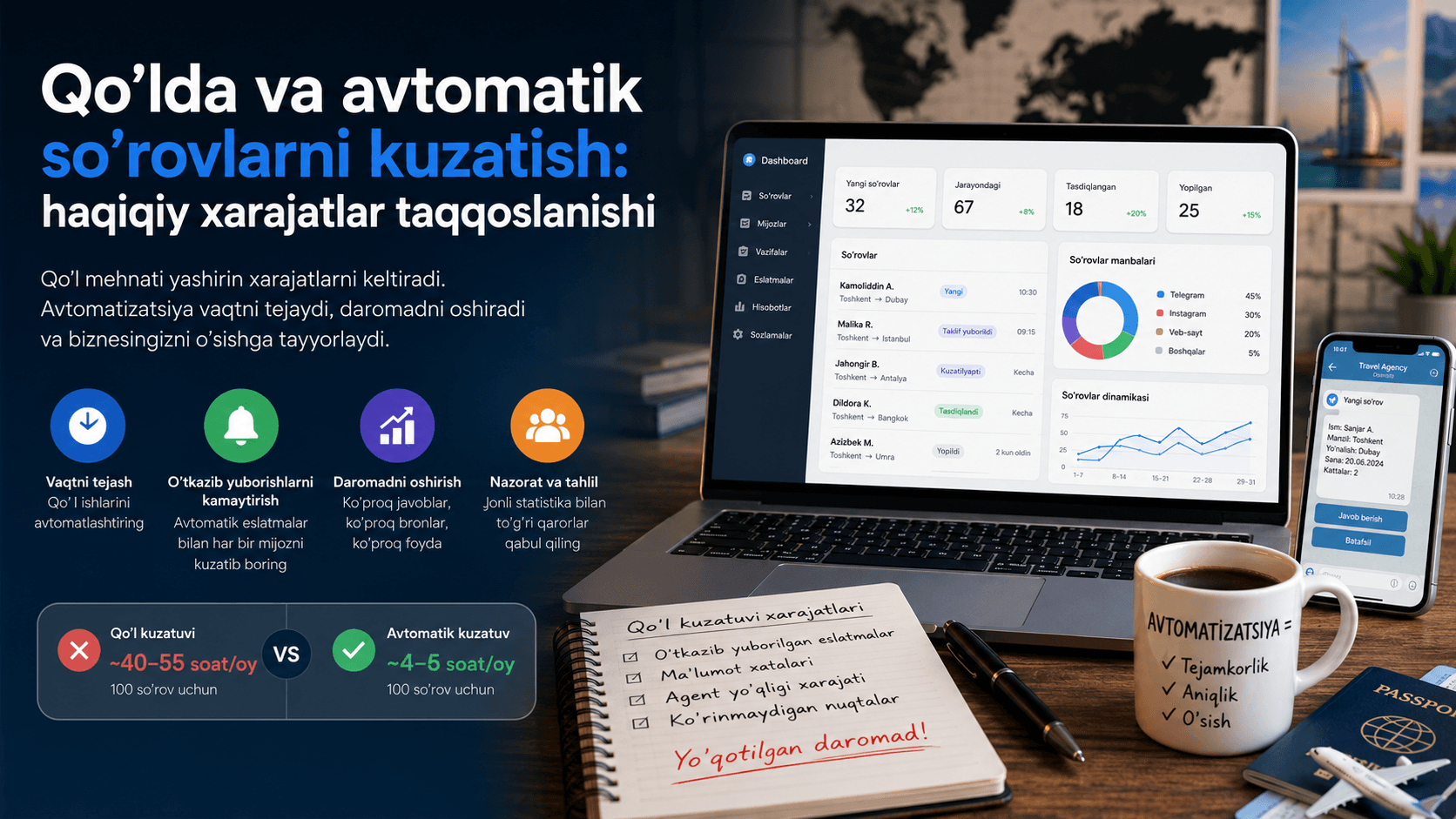
Operations Still Mostly Manual
Despite all of this, a large share of agencies still track enquiries and bookings by hand, which is where the strain shows.
Demand Is Outrunning the Operations
What ties these forces together is a single mismatch: demand is modernising faster than the agencies serving it. Clients have already moved online, they pay digitally, they message instead of call, and they expect a quick, professional response. Many agencies, meanwhile, still run on the same notebooks and personal chats they used years ago. The market has changed around them while their operations stayed the same. This is not a criticism of the people running these agencies, who are often skilled and hardworking; it is a description of a gap that opened quietly as the country's tourism grew. The agencies feeling the strain of busy seasons, lost enquiries, and exhausting manual work are usually not doing anything wrong by the standards of a few years ago. They are simply running a modern volume of business on a setup built for a smaller, slower market.
What Clients Now Expect by Default
It helps to be concrete about what the modern Uzbek traveller now treats as normal rather than impressive. They expect to message an agency on Telegram and get a reply quickly, often within minutes during the day. They expect to pay online with Click or Payme rather than travelling to an office with cash. They expect a clear confirmation and document, not a verbal promise. None of this is luxury anymore; it is the baseline a young, connected population assumes. An agency that still requires a phone call during office hours and cash in person is not just old-fashioned, it is quietly turning away the clients who now expect to do everything from their phone.
The Uzbek travel market is modernising faster than the agencies that serve it. The gap between rising demand and manual operations is exactly where the opportunity sits.
Where Agencies Stand, and Where It Is Heading
The clearest way to read the market is to look at what is still common today versus what is quietly becoming the standard. The agencies that thrive over the next few years are the ones closing the distance between the two columns.
Still Common Today
- Enquiries tracked in a notebook or spreadsheet
- Bookings and payments held in personal chats
- Clients served only during office hours
- Each agent keeping their own clients in their head
- Reports pieced together by hand at month end
Becoming the Standard
- Every enquiry captured in one shared system
- Bookings, payments, and status in one place
- Fast replies and online booking around the clock
- Client data owned by the agency, not the agent
- Live numbers available on a screen any time
The Gap Is the Opportunity
It is tempting to read the persistence of manual operations as a weakness of the industry, but for an individual agency it is the opposite: an opening. When most competitors still answer slowly, lose enquiries, and cannot tell which agent or destination is actually profitable, the agency that fixes those things stands out immediately. You do not have to be the biggest or the cheapest. You have to be noticeably more responsive and organised than the agency next door, which in this market is still a low bar to clear.
That is the quiet story of Uzbek travel in 2026. The demand is there and growing. The clients are online and ready to pay online. The main thing separating a struggling agency from a thriving one is no longer access to customers, it is whether the operation behind the agency can keep up with them.
What This Means for Your Agency
For an agency owner, the takeaway is not to panic about competition but to recognise the moment for what it is. The market is rewarding speed, reliability, and a professional experience more than ever, and the tools to deliver those are now affordable and within reach. The agencies that move from manual habits to organised systems in the next couple of years will capture a disproportionate share of the growth, simply because so many of their competitors will not.
The direction of the market is not in doubt; the only question is who keeps up with it. If you want to position your agency on the right side of that gap, with systems built for how travel works in Uzbekistan today, reach out for a free consultation.