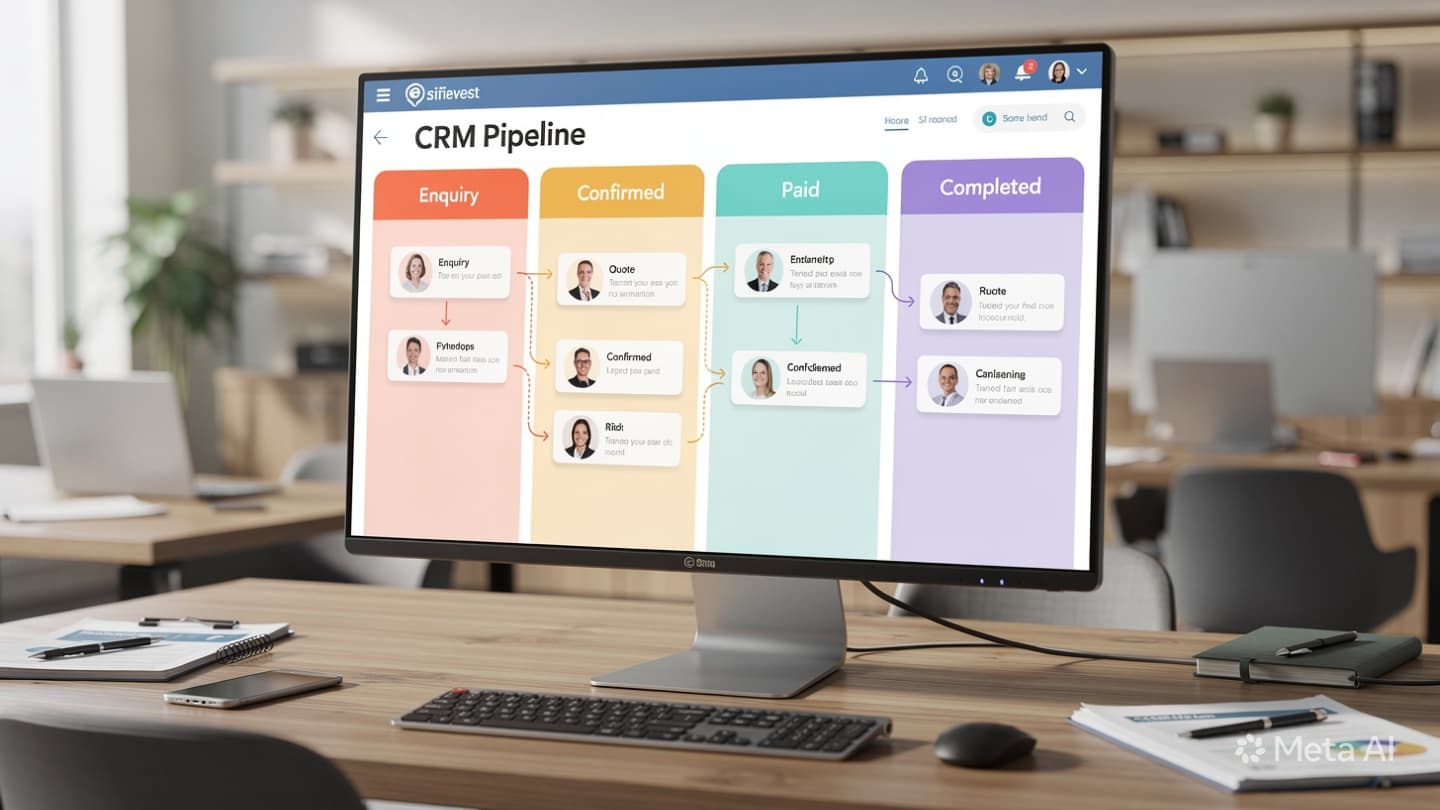

How to Manage 200+ Enquiries a Month Without a Spreadsheet
There's a moment every growing travel agency hits: the spreadsheet that once kept everything organised starts working against you. New rows get added faster than old ones get resolved. Columns multiply. Agents argue over who owns which row. And somewhere in the noise, real clients, with real budgets, get forgotten.
200 enquiries a month sounds like a success metric. And it is. But it's also 10 enquiries every working day, arriving across Telegram, Instagram, your website, and the phone. Without a system built for volume, that number doesn't mean more revenue, it means more chaos.
Where the Spreadsheet Breaks Down
Spreadsheets are genuinely useful, until the volume overwhelms the format. Here's where things go wrong at 200+ enquiries a month:
| Problem | Spreadsheet | CRM |
|---|---|---|
| Multi-channel capture | Manual copy-paste from every inbox | All channels arrive in one queue automatically |
| Agent assignment | Someone adds a name in a cell, or forgets | Assigned automatically or with one click |
| Follow-up reminders | Calendar entries, sticky notes, memory | Automatic reminder triggered by stage change |
| Manager visibility | Scroll 200 rows, interpret colour codes | Dashboard shows open / stalled / overdue at a glance |
| Duplicate enquiries | The same client added twice by two agents | System flags existing client records on entry |
| Staff absence cover | Enquiries sit in one person's inbox until they return | Any agent can pick up any open enquiry instantly |


A Day in the Life: 200-Enquiry Volume Without a CRM
To understand why the spreadsheet breaks, picture a Monday morning at a busy agency. Over the weekend, 18 messages arrived: 7 on Telegram, 4 on Instagram, 4 website forms, and 3 phone calls logged by a colleague on a piece of paper. The first task of every agent's day is manually sorting and entering these into the shared sheet, before a single client has been called back.
By Wednesday, some of those 18 enquiries have been quoted. Others haven't been touched. Nobody knows which ones, because the sheet doesn't distinguish "quoted" from "in progress" from "waiting for client" without someone diligently updating the status cell. By Friday, three clients who wanted to travel next month have already booked with another agency.
"At 200+ enquiries a month, you're not losing clients to better competitors, you're losing them to your own admin backlog. The clients who leave don't complain. They just disappear."
Three Non-Negotiable Features at This Volume
When we help agencies transition from spreadsheets to a CRM, there are three capabilities that make the biggest difference at 200+ enquiries a month. These aren't luxury features, they're the minimum viable replacement for what a spreadsheet can't do:
- Unified inbox. Every Telegram message, website form, Instagram DM, and phone call logged in one place. Agents open one screen in the morning, not five apps. At 200 enquiries a month, multi-tab juggling costs roughly 45 minutes of productive time per agent per day.
- Stage-based pipeline with automatic reminders. When an agent moves an enquiry to "Quoted," the CRM automatically schedules a follow-up reminder for 24 hours later. No calendar entry needed. No chance of forgetting. The system nags on behalf of the agent.
- Manager dashboard with overdue alerts. The owner or manager should never have to scroll a 200-row spreadsheet to find stalled enquiries. A single "Overdue" filter should surface every enquiry that hasn't been touched in more than 4 hours during business hours.
Making the Switch Without Losing Momentum
The fear most agency owners have about switching systems is losing track of existing open enquiries during the transition. This is a real risk, but it's manageable with the right sequence. The approach we recommend:
- Day 1-3: Import your current open enquiries from the spreadsheet into the CRM as a one-time migration. Don't try to import historical closed deals, that can wait.
- Day 4-7: Run both systems in parallel. New enquiries go into the CRM; the spreadsheet is read-only. Agents learn the new workflow with real enquiries but have the spreadsheet as a safety net.
- Week 2: Archive the spreadsheet. From this point, the CRM is the single source of truth. Any enquiry not in the CRM doesn't officially exist.
Most agencies complete this transition in under two weeks with zero lost enquiries when the migration is handled correctly. The staff training time is usually less than four hours total, the interface is simpler than a complex spreadsheet with dozens of columns and colour codes.
Agencies that move from spreadsheets to a pipeline CRM at 200+ enquiries report recovering an average of 12-18 additional bookings per month from leads they were previously losing to follow-up gaps.
The Real Question Isn't "Should We Switch?", It's "When?"
At some volume, the spreadsheet always breaks. For most travel agencies in Uzbekistan, that threshold is somewhere between 80 and 150 enquiries a month, well before 200. If you're already at 200+, you're not asking whether to switch; you're calculating the cost of every week you don't.
Implementation doesn't require months of planning or a large IT budget. A well-configured CRM for a travel agency can be live and used by your whole team within a week. If you want to see what that setup looks like for your specific workflow and team size, book a free consultation with us. We'll audit your current process and build a migration plan with no obligation.