
API Integrations Every Travel Agency Should Know About
The word API sounds like something only developers need to care about, but every travel agency already depends on them, usually without naming them. When a payment link marks a booking as paid, when a Telegram message becomes an enquiry in your system, when a website form turns into a lead, an API is doing the work behind the scenes. An API, short for application programming interface, is simply the way two pieces of software talk to each other and pass information automatically.
You do not need to understand the technology to make good decisions about it. You need to know which connections are worth having, because each one removes a manual step where an agent currently copies data from one place to another by hand. Those manual steps are slow and where mistakes happen, so the integrations that remove them are where the real value sits.
The Hidden Cost of the Gaps Between Tools
Before listing the connections, it helps to see what the gaps between your tools actually cost. Every place two systems do not talk is a place a person has to. An agent reads a payment confirmation and types it into the booking. Another copies a website enquiry into the CRM. A third re-enters the month's paid bookings into the accounting software. None of these take long alone, but together they consume hours every week and quietly introduce errors, a transposed figure here, a forgotten entry there. The gaps also slow everything down: a payment that should mark a booking paid instantly instead waits until someone gets around to updating it. Integrations are valuable precisely because they close these gaps, turning work that a person does into something that happens on its own.
What an API Actually Does, in Plain Terms
Think of an API as a standard doorway between two systems. Without it, moving information from your payment provider to your booking record means a person reads one screen and types into another. With it, the payment provider hands the information straight to your booking system through that doorway, in seconds, with no one in between. The same doorway lets your website send an enquiry to your CRM, or your booking system send an invoice to your accounting software.
That is the whole idea: instead of a human carrying data between tools, the tools pass it directly. Everything below is just a list of which doorways are worth opening for a travel agency, and what each one saves you.
The Integrations Worth Knowing About
Payment Gateways (Click, Payme)
So a client pays online and the booking is marked paid automatically, with no agent confirming it by hand.
Messaging (Telegram)
So enquiries from a bot or channel land directly in your system, and confirmations go out without copy-paste.
Supplier and GDS Systems
So fares, availability, and bookings flow between you and your suppliers instead of being re-keyed from a portal.
Website Forms
So an enquiry submitted on your site becomes a lead in your CRM the instant it is sent, not a forwarded email.
Accounting Software
So paid bookings and invoices reach your books automatically, instead of being typed in again at month end.
Analytics
So you can see which channels and pages actually produce bookings, tied back to real revenue.
Every API integration removes one place where an agent retypes a number. That is the whole value: fewer manual steps, fewer mistakes, faster work.
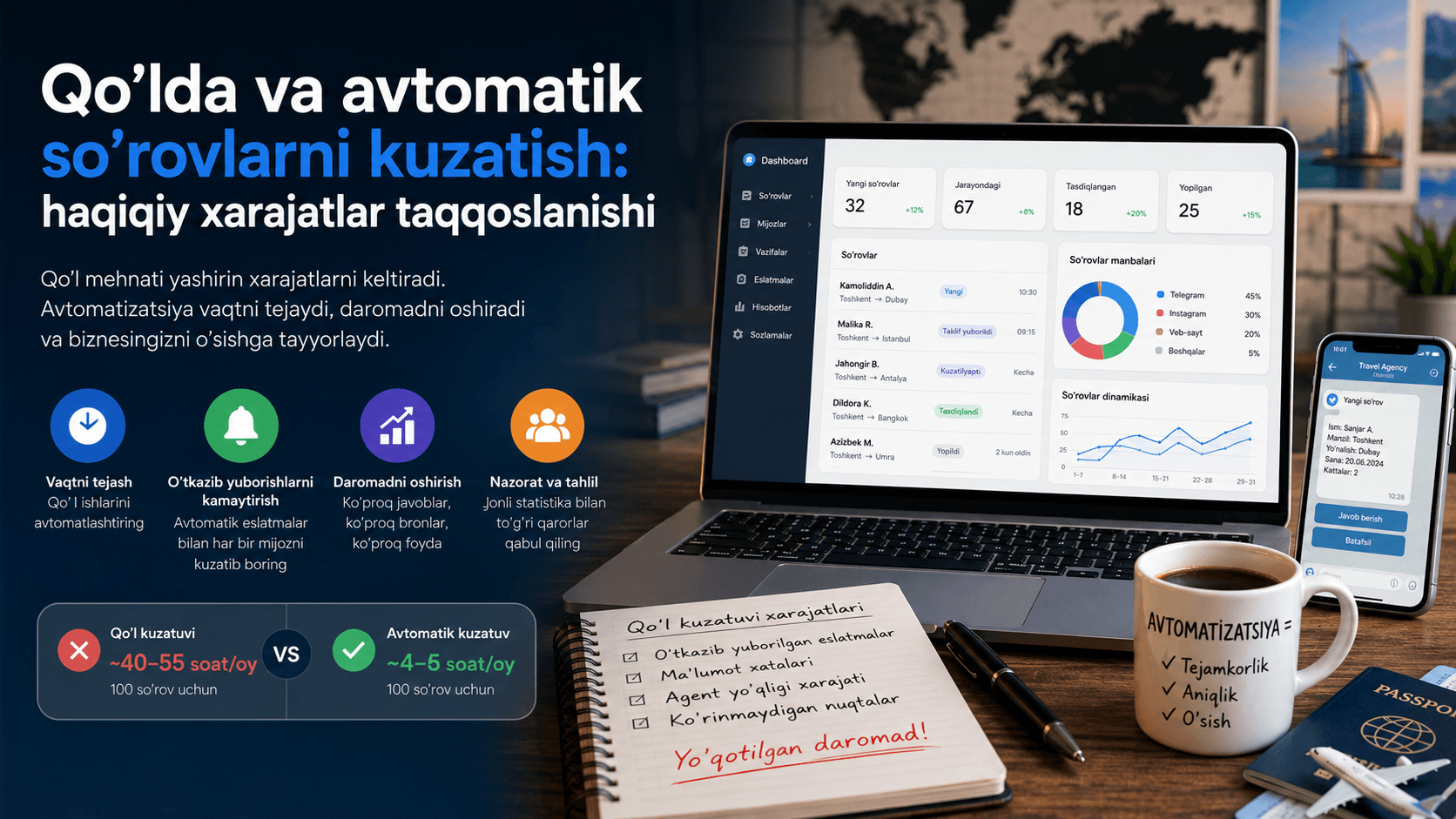
Manual Re-Entry vs Connected via API
Manual Re-Entry
- A payment confirmed, then typed into the booking
- An enquiry forwarded, then copied into the CRM
- The same number entered in three places
- Errors and delay at every handoff
Connected via API
- A payment marks the booking paid by itself
- An enquiry becomes a lead the moment it arrives
- Each number entered once, shared everywhere
- No human carrying data between tools
You Do Not Need Them All at Once
Seeing a list of six integrations can make it feel like a huge project, but the right approach is one at a time, starting with the connection that hurts most today. For many agencies that is payments, because confirming each payment by hand is both slow and a common source of mistakes. For others it is the website-to-CRM link, because lost enquiries cost the most.
Pick the single manual step your agents repeat most often and connect that first. Each integration you add pays for itself in saved time before you move to the next, and adding them gradually means your team adjusts to one change at a time instead of a confusing overhaul. There is no prize for connecting everything at once, only the same benefit arriving more slowly and with more disruption.
A Good Integration Removes a Human Step
The simple test for whether an integration is worth it is to ask what manual step it removes. A connection that just moves data you never use is not worth the effort. A connection that means a payment, an enquiry, or an invoice no longer has to be retyped by a person is almost always worth it, because it saves time every single day and removes a place where errors creep in. Counted across a year, those removed steps add up to weeks of agent time and a long list of mistakes that simply never happen.
Judge every integration by that standard rather than by how modern it sounds. The goal is not to have the most connections. It is to remove the manual steps where your agents currently act as the glue between systems that should be talking to each other directly. If you want your tools connected so payments, enquiries, and invoices stop being retyped by hand, reach out for a free consultation.